As industries continue to push toward greater efficiency, reliability, and electrification, advanced electrical control systems have become the true backbone of modern equipment standards. From marine and defense applications to industrial and energy systems, modern hybrid and fully electric platforms demand intelligent controls that offer more than simply turning components on and off. Now, they must be able to seamlessly manage power while providing precise feedback and adaptation to complex operating conditions in real time. Supreme Integrated Technology is able to meet these unique challenges by providing advanced electrical control solutions that are engineered specifically for highly demanding environments.
By shifting toward smarter control, the standard for system design and integration is being reshaped everyday. SIT uses deep electrical expertise with in-house mechanical and structural engineering capabilities to deliver highly intelligent control systems that are fully integrated, highly customizable, and built to perform under the most rugged conditions. Use this blog as your guide to learning what makes SIT’s electrical control solutions smarter and more efficient, regardless of application.
What is the Role of Modern Control Systems?
Electrical control solutions have evolved beyond simple switchboards and relay logic. Today, they work as the central intelligence of complex machinery, coordinating motion, regulating power distribution, and processing feedback signals. This allows for safe, reliable operation across both hybrid and fully electric systems. Now, control systems are no longer a supporting component, but instead the system’s overarching command center.
The primary avenue for operation can be found in the management of communication between key aspects of a system, including:
- Sensors
- Drives
- Actuators
- Motors
- Hydraulic components
By using programmable logic controllers (PLCs), variable frequency drives (VFDs), and sophisticated control algorithms, these electrical control systems can continuously monitor performance variables. These variables include load, pressure, temperature, and speed–all of which can vary greatly across various applications. Responding in real time, they can adjust outputs to maintain optimal precision and efficiency, in turn preventing faults before they turn into large-scale failures and system-wide downtime.
Intelligent Electrical Control Solutions for Modern Demands and Hybrid Systems
Advanced electrical intelligence becomes even more essential within hybrid electrohydraulic systems, where electrical commands must be able to flawlessly coordinate with hydraulic power to produce smooth, precise motion. Within these systems, accurate synchronization between multiple electrical inputs and hydraulic responses is paramount–with perfect execution resulting in minimizing lag, reduced mechanical stressors, and improved responsiveness. Over time, these advancements can extend equipment lifecycles and overall system durability.
Beyond motion control and long-term system durability, intelligent electrical control solutions are specifically designed to address the most pressing operational demands of the industry. These specific needs are addressed with:
- Real time system diagnostics for faster troubleshooting
- Remote monitoring and data integration to support digital operations
- Energy optimizations strategies to reduce consumption and costs
- Scalable architectures that integrate with future system upgrades
- Improved safety protocol through automated fault detection and protective logic
Hybrid Electrohydraulic Control Solutions at SIT
Hybrid electrohydraulic systems use both the power density of hydraulics with the precision and intelligence of advanced electrical control solutions. These systems are essential for high-performance applications where strength, responsiveness, and reliability are non-negotiable, including marine equipment, defense systems, heavy industrial machinery, and energy infrastructure. Within these environments, seamless coordination between electrical commands and hydraulic power is vital for safe and accurate operations.
The backing of the hybrid electrohydraulic platform is its control design. Electric signals are what initiate and regulate the hydraulic function, allowing pumps, valves, actuators, and motors to move with calculated accuracy. At SIT, our goal is to design control systems that ensure electrical inputs and hydraulic responses are perfectly in synchronizations, which in turn minimizes drag and maximizes performance.
The primary aspects of SIT’s approach to hybrid control systems include:
- Custom PLC integration for precise common and feedback control
- Advanced HMI interfaces to provide operators with intuitive system operation
- Closed-loop feedback systems for accurate pressure, flow, and motion regulation
- Seamless coordination between electrical panels and HPUs
By combining the electrical and mechanical aspects of a system in-house, SIT is able to ensure true integration, not just basic component compatibility. Multidisciplinary skills allow SIT to optimize the way electrical control planes communicate with the hydraulic power packs, steering systems, winches, and lifting mechanisms, as well as other important equipment. The result is smoother operation, improved responsiveness, and reduced mechanical wear.
Unique Challenges of Hybrid Electrohydraulic Systems
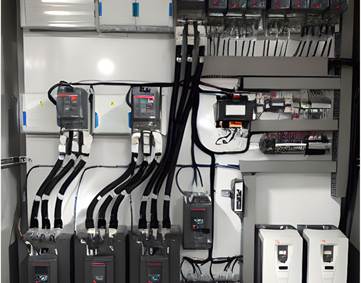
Hybrid electrohydraulic systems also present unique challenges. Because they are usually operating in harsh environments, including offshore marine conditions, high-vibration industrial settings, or defense applications where unexpected glitches or mechanical failure is not an option. SIT specifically addresses these problems by designing control systems that are rugged, reliable, and built to withstand the most demanding operational conditions. Individual components are selected for durability, control enclosures are engineered for environmental protection, and system logistics are developed with long-term performance in mind.
Key Advantages of SIT Electrohydraulic Control Systems
Another key advantage of SIT’s hybrid solutions is system optimization. Rather than relying on generic programming, SIT develops tailored control strategies specific to the application’s load requirements, duty cycles, and operational goals. This customization enhances efficiency, reduces energy waste, and improves overall equipment lifespan. The applications that benefit the most from the combined ability to regulate large, heavy loads while working with utmost precise include:
- Marine winch and hoisting systems: Electrical controls regulate hydraulic torque and line speed in real time, which helps enable smooth load handling, safer lifting operations, and reduced mechanical shock during starts and stops.
- Ballast control systems for vessels or offshore platforms: Intelligent control logic accurately manages hydraulic valves and pumps to maintain vessel stability, improve response time during heavy load shifts, and enhance operational safety in rapidly changing sea conditions.
- Hydraulic steering systems: Closed-loop electrical feedback continuously alters hydraulic pressure and flow to deliver precise steering response, which can improve maneuverability and reduce component wear.
- Movable structures such as heavy lift mechanisms or positioning equipment: Coordinated electrical commands synchronize multiple hydraulic actuators, ensuring perfectly balanced motion, structural alignment, and consistent load distribution.
No matter how demanding the application, electrohydraulic control systems are the future of reliability and performance.
Benefits of Fully Electric Control Packages
Many industries are beginning to shift toward fully electric systems as their preferred solution for applications that demand unyielding precision combined with simplified mechanical architecture. Unlike hybrid platforms that utilize hydraulic power, fully electric systems operate entirely through motors, drives, and electronically controlled components. Because of this, the electrical control system becomes the hinge point of performance quality and reliability–not only responsible for operations, but also energy management, motion control, and system protection.
SIT develops fully electrical control solutions that are engineered to offer extremely responsive, highly regulated performance across a vast range of unique applications. By prioritizing both advanced control logic with drive and motor system quality, SIT is able to ensure precise unison of torque, speed, positioning, and energy use.
How Precision Control is Impacted by Intelligent Architecture
When it comes to fully electric systems, the biggest influence of operational performance is control accuracy. SIT’s control architectures continuously monitor system inputs and are able to adjust outputs dynamically, which creates optimal stability and reliability. By utilizing programmable logic controllers, variable frequency drives, and custom control algorithms, SIT’s fully electric control systems regulate motion with unmatched precision.
A high level of intelligent regulation allows equipment to:
- Deliver smooth acceleration and deceleration
- Maintain consistent torque under varying load weight
- Optimize power consumption across duty cycles
- Prevent overloads and protect critical components
- Achieve highly repeatable motion and positioning
These benefits are largely due to the instantaneous response time, enabling tighter control and predictable performance.
Engineering Integration Powering Intelligent Control
In order to deliver a high-performance control system, more is required than simply advanced electrical components: it demands completely seamless system integration from top to bottom. The true strength of modern hybrid and fully electric platforms lies in how electrical, mechanical, and structural elements function together as one coordinated system. This is where SIT’s engineering depth and multidisciplinary knowledge make a measurable difference in the performance.
At SIT, electrical control solutions are not developed singularly. Instead, they are engineered as a portion of a fully integrated system, specifically designed alongside mechanical assemblies, hydraulic components, and structural frameworks. This approach ensures that control logic is perfectly aligned with how each piece of equipment moves, responds, and performs in real-world, demanding applications.
The final defining advantage of partnering with SIT for advanced electrical control solutions is the customization expertise found in our team. Instead of relying on standardized control packages, SIT develops solutions built specifically for every system’s unique function, load requirements, and performance expectations. Because of this, we are able to enable organizations to operate with greater precision and longeiveity–collectively powering the future of advanced electrical control solutions, including both fully electric and hybrid designs.
Frequently Asked Questions
Q: Why are customized electrical control solutions better than off-the-shelf systems?
A: Off-the-shelf electrical control solutions are designed for general use, which can limit performance in specialized or demanding environments. Customized control systems are engineered specifically for the equipment, operating conditions, and performance requirements of the application. This tailored approach improves integration, enhances reliability, optimizes efficiency, and reduces the risk of compatibility issues that can lead to failure.
Q: How do advanced electrical control solutions improve long-term operational reliability?
A: Advanced electrical control solutions improve reliability by continuously monitoring system performance, detecting faults early, and adjusting operation in real time to prevent excessive wear or failure.
Q: Which industries benefit most from advanced electrical control solutions?
A: Advanced electrical control solutions are especially valuable in industries that rely on precise motion, heavy loads, or continuous operation. This includes marine and offshore equipment, defense systems, industrial manufacturing, energy infrastructure, and large-scale material handling.
Contact SIT today to learn more about our advanced electrical control solutions and how they can impact your operation.